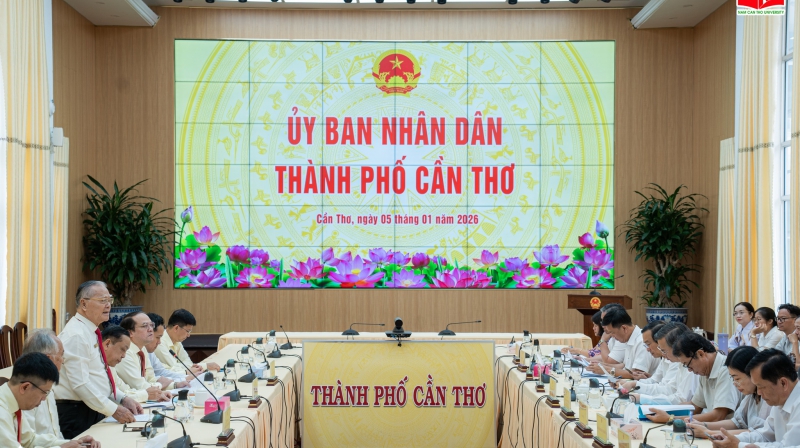
On the afternoon of December 28, 2025, in Can Tho City, Minister Pham Minh Chinh, along with the Can Tho City Assembly Delegation, held a thematic meeting with constituents on healthcare and education. The meeting was attended by representatives from various departments, agencies, state management bodies, educational and healthcare institutions, as well as lecturers, scientists, and experts in the area.
Attending the meeting, Nam Can Tho University actively contributed opinions, demonstrating its role and responsibility as a higher education institution in accompanying the Party, State, and Government in formulating policies for educational development and training high-quality human resources for the Mekong Delta region.
Speaking at the conference, Dr. Nguyen Van Quang, Party Commitee Secretary and Rector of Nam Can Tho University, expressed his enthusiasm and emphasized the important significance of Resolution No. 71-NQ/TW of the Politburo on breakthroughs in education and training development. The resolution identifies higher education as a key driving force in developing high-quality human resources, requiring university autonomy to go hand in hand with ensuring resources and regional equity.
Based on its practical experience in training, scientific research, and regional development, Nam Can Tho University proposes that the Minister consider issuing breakthrough policies on university autonomy to create conditions for the Mekong Delta to truly become a key driving force in the development of high-quality human resources in accordance with Resolution 71. Specifically, the University proposes five key mechanisms:
Representatives from Nam Can Tho University emphasized that Resolution 71-NQ/TW of the Politburo sets the goal of developing high-quality human resources and enhancing national competitiveness, with university autonomy being a breakthrough. However, the Mekong Delta region, despite its great potential, still lacks sufficiently strong mechanisms; the high-skilled human resources do not yet meet the requirements of autonomy and digital transformation. Therefore, "superior" mechanisms are urgently needed to attract talent and effectively mobilize social resources to invest in higher education.
The participation and contributions of Nam Can Tho University at the meeting with the Prime Minister further affirm its role as an intellectual institution, its social responsibility, and its commitment to accompanying the sustainable development of Can Tho City and the Mekong Delta region, contributing to the effective implementation of the Party and State's major policies on fundamental and comprehensive reform of education and training in the new period.



 VN
VN